
How to Go From Day Laborer to Crew Lead
Crew leads are made on the job, one extra responsibility at a time.
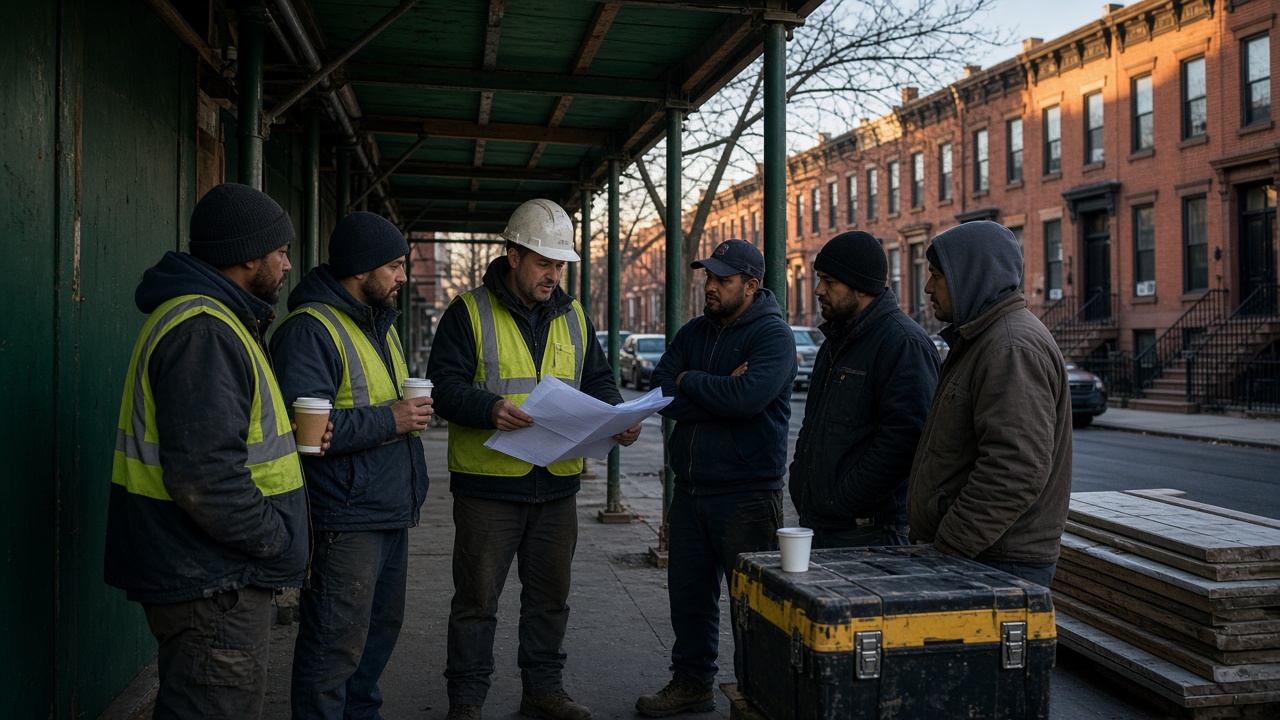
Crew leads are made on the job, one extra responsibility at a time.
Most foremen and crew leads did not start with a degree. They started carrying material, learned the work, and became the person everyone turned to when something needed to get done. If you want to lead a crew someday, the path is real and well-paid. This guide explains what crew leads and foremen do, what the role pays, and the concrete steps from day labor to leading a crew.
What a crew lead or foreman does
O*NET, the Labor Department's job database, groups these roles as first-line supervisors of construction trades. Its sample job titles include construction foreman, construction supervisor, and field supervisor (https://www.onetonline.org/link/summary/47-1011.00). Their core tasks include.
- Inspecting work progress, equipment, and sites for safety and to make sure specifications are met
- Reading blueprints and specifications to plan the work
- Supervising, coordinating, and scheduling the crew
- Assigning work based on the job and each worker's skills
- Estimating material and worker needs and ordering supplies
- Training workers in construction methods, equipment, and safety procedures
O*NET also reports that 78 percent of these supervisors say they have very high responsibility for the health and safety of other workers. That is the heart of the job: getting the work done right without anyone getting hurt.
What it pays
ONET lists a 2025 median wage of $38.42 an hour, or $79,920 a year, for first-line supervisors of construction trades, with about 913,300 people in the role, faster-than-average projected growth, and about 67,000 projected openings. Compare that with the May 2025 median of $22.44 an hour for construction laborers and helpers reported by the Bureau of Labor Statistics (https://www.bls.gov/ooh/construction-and-extraction/construction-laborers-and-helpers.htm). ONET also reports that 63 percent of these supervisors work more than 40 hours a week, so the higher pay comes with longer days and more responsibility.
Is it realistic to go from day labor to crew lead?
Yes. BLS says that after gaining experience, construction laborers may have opportunities to supervise staff, oversee jobsites, or start their own business. For carpenters, BLS lists first-line supervisor and lead carpenter among the advancement paths (https://www.bls.gov/ooh/construction-and-extraction/carpenters.htm). O*NET classifies the supervisor role as needing medium preparation, usually one or two years of training with experienced workers on top of related experience.
The skills crew leads need
O*NET lists active listening, speaking, critical thinking, monitoring, and coordination among the key skills for construction supervisors. In job site terms, that means.
- Knowing the work well enough to teach it
- Planning the day: what comes first, what materials are needed, who does what
- Clear communication with workers, the boss, other trades, and clients
- Spotting hazards and fixing them before work starts
- Basic math for layout, quantities, and estimates
- Staying calm and fair when things go wrong
- In many crews, speaking both English and Spanish
Step 1: Become the most reliable person on the crew
Leadership starts with trust. Be early, finish what you start, keep your area clean, and never need to be told twice. Supervisors pick leads from the people they never have to worry about.
Step 2: Learn the whole job, not just your part
Pay attention to the order of work, the materials, the plans, and why things are done the way they are. Ask the foreman how they plan a day. Learn to read basic plans. A crew lead needs to see the whole job, not just the next task.
Step 3: Take small responsibilities and do them well
Volunteer for the jobs nobody wants that show you can lead.
- Opening or closing the site
- Checking that tools and materials are ready for tomorrow
- Showing a new worker where things are
- Counting materials and telling the foreman what is running low
- Keeping a simple daily log of what got done
Step 4: Get the training supervisors need
OSHA says its 30-hour Outreach course is more appropriate for supervisors or workers with safety responsibility, while the 10-hour course is aimed at workers (https://www.osha.gov/training/outreach). If you have the OSHA 10, the OSHA 30 is a natural next step toward leading a crew.
Some places require more. In New York City, supervisors on sites covered by Local Law 196 need a Supervisor Site Safety Training card showing at least 62 hours of training, compared with 40 hours for workers (https://www.nyc.gov/site/buildings/safety/sst-worker-information.page).
Learn what a "competent person" is. OSHA's construction rules define a competent person as someone capable of identifying existing and predictable hazards who has authorization to take prompt corrective measures to eliminate them (https://www.ecfr.gov/current/title-29/subtitle-B/chapter-XVII/part-1926/subpart-C/section-1926.32). Several rules require one, for example to train workers who erect or take down scaffolds (https://www.ecfr.gov/current/title-29/subtitle-B/chapter-XVII/part-1926/subpart-L/section-1926.454). Crew leads are often expected to grow into that role for their area of work.
Step 5: Learn to teach
Federal construction rules require employers to instruct each employee in recognizing and avoiding unsafe conditions (https://www.ecfr.gov/current/title-29/subtitle-B/chapter-XVII/part-1926/subpart-C/section-1926.21). On many crews, that instruction comes from the lead. Practice explaining a task simply, showing it once, watching the worker try, and correcting kindly. A short morning talk about the day's hazards is a good habit to copy from experienced foremen.
Step 6: Tell your boss you want it
Many workers wait to be noticed. Say it directly, at a good moment, and ask what you need to work on. Here is an example.
I want to run a crew someday. What would you need to see from me to trust me with a small crew on a simple job?
Then do what they say, and check back in a few months.
Common mistakes new crew leads make
- Doing all the work themselves instead of directing the crew
- Playing favorites
- Skipping the safety check because the crew is behind
- Hiding problems from the boss or client
- Correcting workers harshly in front of others
A realistic example path
This is an illustration, not a typical or guaranteed timeline.
- Year 1: day labor and laborer jobs; OSHA 10; become a reliable regular for two or three contractors
- Year 2: helper in one trade; take opening and closing duties; learn basic plan reading
- Year 3: lead a two- or three-person crew on small jobs; take the OSHA 30
- Later: foreman on bigger jobs, or start a small crew of your own
Keep finding the right jobs along the way
While you grow, keep your options open. Workers use ChambaNOW free to post skills and availability and get notified when jobs are available at https://chambanow.com/for-workers, and you can browse construction work in cities such as New York at https://chambanow.com/jobs/in/new-york-ny/construction, Chicago at https://chambanow.com/jobs/in/chicago-il/construction, and Houston at https://chambanow.com/jobs/in/houston-tx/construction.
Key takeaways
- Crew leads and foremen plan, assign, train, inspect, and keep the crew safe
- O*NET lists a 2025 median of $38.42 an hour for first-line construction supervisors, versus $22.44 for laborers and helpers
- BLS says experienced laborers may move into supervising staff and overseeing jobsites
- Build trust first, learn the whole job, take small responsibilities, and get supervisor-level safety training such as the OSHA 30
- Tell your boss you want to lead, and ask what you need to show
Sources
- O*NET OnLine, 47-1011.00 First-Line Supervisors of Construction Trades and Extraction Workers: https://www.onetonline.org/link/summary/47-1011.00
- U.S. Bureau of Labor Statistics, Construction Laborers and Helpers: https://www.bls.gov/ooh/construction-and-extraction/construction-laborers-and-helpers.htm
- U.S. Bureau of Labor Statistics, Carpenters: https://www.bls.gov/ooh/construction-and-extraction/carpenters.htm
- OSHA, Outreach Training Program: https://www.osha.gov/training/outreach
- NYC Department of Buildings, SST Card Information: https://www.nyc.gov/site/buildings/safety/sst-worker-information.page
- 29 CFR 1926.32, Definitions (competent person): https://www.ecfr.gov/current/title-29/subtitle-B/chapter-XVII/part-1926/subpart-C/section-1926.32
- 29 CFR 1926.454, Scaffold training: https://www.ecfr.gov/current/title-29/subtitle-B/chapter-XVII/part-1926/subpart-L/section-1926.454
- 29 CFR 1926.21, Safety training and education: https://www.ecfr.gov/current/title-29/subtitle-B/chapter-XVII/part-1926/subpart-C/section-1926.21
Written by Barry Graham, Founder, ChambaNOW
Building knowledge that works.