
How Do You Get EPA 608 Certification for HVAC Work?
You earn EPA 608 certification by passing approved refrigerant exams that match the equipment you will service.
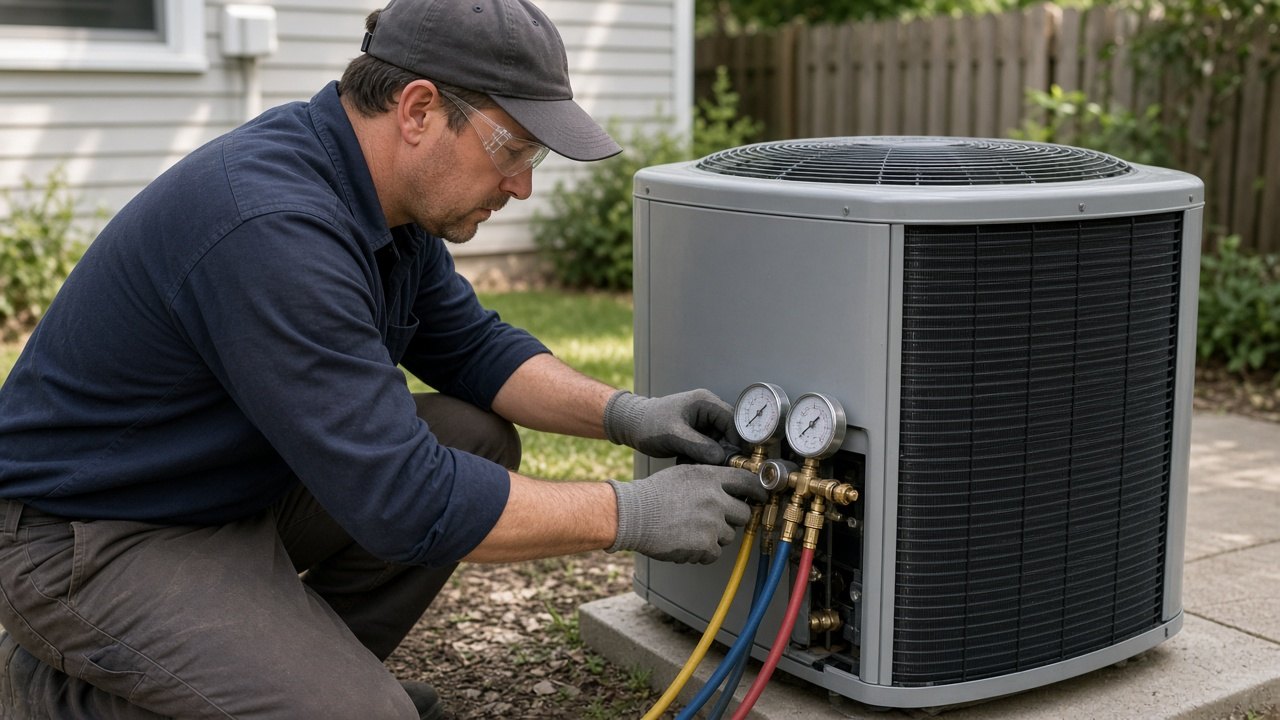
You earn EPA 608 certification by passing approved refrigerant exams that match the equipment you will service.
EPA Section 608 certification is an important HVAC credential, but it is not the same as completing HVAC school or obtaining every license your state may require. It addresses refrigerant-related work, with different certification types for different equipment.
That distinction matters when a course advertises a universal HVAC certificate. Ask what exam you are taking, which organization administers it, and what the resulting credential actually covers before paying.
Who needs EPA 608 certification?
EPA says technicians who maintain, service, repair, or dispose of equipment that could release refrigerants into the atmosphere must meet its certification requirements. The agency defines technician activities to include attaching and detaching gauges or hoses to measure pressure and adding or removing refrigerant.
A helper job title does not automatically create an exemption. EPA states that apprentices are exempt only when closely and continually supervised by a certified technician. Ask the employer how that supervision works before touching a refrigerant circuit.
Do not confuse Section 608 with every other automotive or HVAC credential. EPA's types and exceptions are equipment-specific. Explain the actual equipment you expect to work on when choosing a test.
What are Type I, Type II, Type III, and Universal?
EPA identifies these certification categories.
- Type I, for servicing small appliances
- Type II, for servicing or disposing of high- or very high-pressure appliances, except small appliances and motor vehicle air conditioners
- Type III, for servicing or disposing of low-pressure appliances
- Universal, for servicing the equipment covered by all the types
Universal is broader, but it is not a blanket trade license. It does not prove that you can diagnose every electrical fault, install every system, or work independently under state contractor rules.
Ask a prospective employer which category fits the work. Someone focused on a specific equipment type may have a different immediate need from a technician preparing for varied service assignments.
How do you take the exam?
EPA requires tests administered by an EPA-approved certifying organization. Its official Section 608 page links to certification programs and test topics. Start there instead of trusting an advertisement that merely uses the EPA name.
Ask the provider to identify the testing organization, exam format, identification requirements, retest procedure, and credential delivery process. Some training programs prepare you for an exam but do not include the exam itself.
EPA does not issue certification cards directly. Keep the certifying organization's contact details because it is important if you later need to verify or replace your credential.
Can you get EPA 608 certified online?
The important issue is not simply whether a screen is involved. It is whether the exam follows the approved certification rules for your target credential. EPA specifically states that an open-book Core exam cannot be used toward Universal certification.
For Universal, Core must be taken as a proctored exam. Before choosing an online offering, ask which parts are proctored and whether the complete result qualifies for Universal. Do not assume an open-book Type I route has the same scope.
Written training materials can help you prepare, but they are not evidence that you passed an approved exam. Keep course completion and official certification results separate when describing your qualifications.
What should you study?
Use the EPA test-topic links and the current preparation material recommended by the approved testing organization. Build your study around understanding refrigerant handling and environmental responsibilities, not memorizing a list without knowing how it applies.
Connect theory with supervised shop instruction where available. Ask why a procedure is necessary, what equipment category it concerns, and when a task must stop for a more experienced technician.
Your preparation checklist should include these practical questions.
- Which certification types am I testing for?
- Does my Core exam meet Universal requirements if that is my goal?
- Is the test included in the course fee?
- What happens if I pass some sections but not others?
- How will I receive and verify the result?
Does EPA 608 expire?
EPA states that Section 608 technician certification credentials do not expire. That does not mean the trade stops changing or that state licenses and employer requirements disappear.
Continue learning the equipment, refrigerants, safety practices, and rules relevant to your job. A permanent credential is a reason to protect your records, not a reason to stop training.
Ask the certifying organization how replacement documentation works and save a copy of your result. Do not wait until a job application deadline to discover that you cannot identify who certified you.
How much does certification cost?
EPA does not publish one nationwide tuition-and-exam price for all providers. Request an itemized quote covering preparation materials, instruction, testing, retests, and any separate credential fees.
Ask an employer, community college, or American Job Center whether training assistance is available. CareerOneStop explains that eligible people may qualify for WIOA-supported training through local providers, but approval is not automatic.
Compare a short exam-preparation offering with a full HVAC program carefully. BLS says postsecondary HVAC programs generally last six months to two years. A refrigerant exam is not an equivalent replacement for that broader training and supervised experience.
How does EPA 608 connect to an HVAC career?
BLS reported a May 2025 national median annual wage of $61,010 for heating, air conditioning, and refrigeration mechanics and installers. That is an occupation-wide median, not a salary earned simply by passing Section 608.
BLS also notes that some states and localities require HVAC licenses. Check the rules where you will work and ask whether a helper or apprentice must register. Never advertise independent regulated work based only on a refrigerant credential. BLS also notes that manufacturer and industry certifications exist for HVAC technicians, and some employers prefer specific ones, so ask which credentials local employers actually value before adding more tests.
For a realistic look at early duties, read our HVAC installation helper guide at https://chambanow.com/chambamatters/hvac-installation-helpers-skills-rates-and-experience-requirements. Workers can find local trade and labor jobs free at https://chambanow.com, including mechanical work listings in Houston at https://chambanow.com/jobs/in/houston-tx/mechanical.
Frequently asked questions
Is Universal required for every HVAC helper?
Not necessarily. The actual task, equipment, and supervision determine what applies. Ask the employer to explain the work before choosing an exam.
Can EPA 608 replace a state HVAC license?
No. Federal refrigerant certification and state or local occupational licensing are different requirements.
Can I work with refrigerant while training?
EPA describes an apprentice exemption only under close and continual supervision by a certified technician. Confirm that arrangement before performing covered work.
What is the best next step?
Identify your target equipment, find an EPA-approved certifying organization, and compare the exam and training options. Keep your career goal broader than a single credential.
Sources
- EPA, Section 608 Technician Certification (https://www.epa.gov/section608/section-608-technician-certification-0)
- EPA, Section 608 Technician Certification Requirements (https://www.epa.gov/section608/section-608-technician-certification-requirements)
- eCFR, 40 CFR 82.161 (https://www.ecfr.gov/current/title-40/chapter-I/subchapter-C/part-82/subpart-F/section-82.161)
- BLS, Heating, Air Conditioning, and Refrigeration Mechanics and Installers, May 2025 (https://www.bls.gov/ooh/installation-maintenance-and-repair/heating-air-conditioning-and-refrigeration-mechanics-and-installers.htm)
- CareerOneStop, Find money for training (https://www.careeronestop.org/FindTraining/Pay/find-money-for-training.aspx)
Written by Barry Graham, Founder, ChambaNOW
Building knowledge that works.