
How Do You Become a Plumber? Apprenticeship and License Steps
A plumbing apprenticeship pairs paid supervised work with classroom instruction and leads toward a plumbing license.
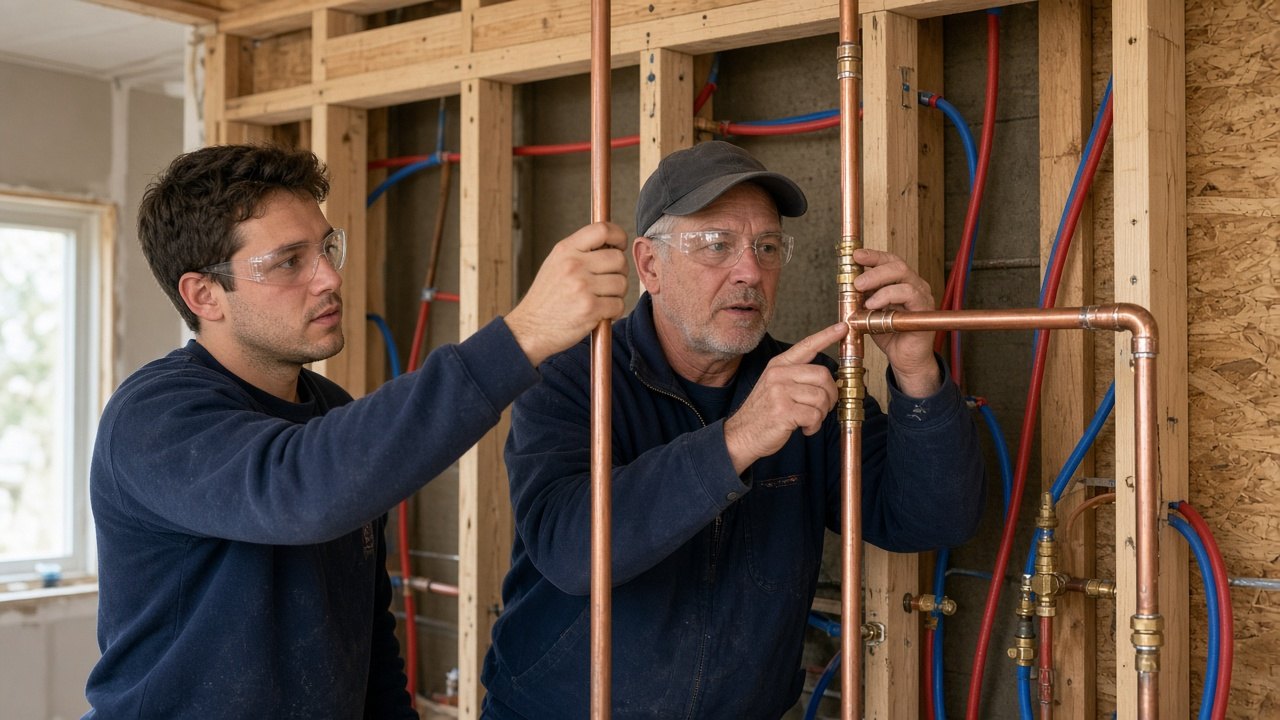
A plumbing apprenticeship pairs paid supervised work with classroom instruction and leads toward a plumbing license.
Plumbing helper work and plumbing apprenticeship are related, but they are not identical. A helper may support a crew without being enrolled in a recognized training pathway. An apprentice should understand how work hours, classroom instruction, and supervision lead toward a defined occupational goal.
The practical starting point is your state or local licensing authority. BLS says most states and some localities require plumbers to be licensed. Requirements for plumbing, pipefitting, steamfitting, and gas work are not necessarily the same.
How long is a plumbing apprenticeship?
BLS describes most plumbing, pipefitting, and steamfitting apprenticeships as four or five years. Apprentices typically receive about 2,000 hours of paid on-the-job training each year plus technical instruction.
That is a typical national description, not a promise that every applicant completes the same calendar. Your program and licensing authority determine the work, instruction, documentation, and progression requirements that apply.
Technical instruction includes safety, plumbing codes, blueprint reading, mathematics, applied physics, and chemistry. The work is more than joining pipe: you are learning how systems function and how to install or repair them to the applicable standard.
Where can you find plumbing apprenticeships?
Apprenticeship.gov lets career seekers search opportunities and apply directly to an employer or sponsor. BLS identifies unions, trade associations, and businesses as apprenticeship sponsors in these trades.
Check several sponsors serving your area. Ask when they accept applications, whether they are hiring now or maintaining a pool, and what selection steps apply. A training center's existence does not mean it has an immediate opening.
An American Job Center can help you find training contacts and understand possible support. Use the official finder rather than paying someone merely to provide a list of public apprenticeship opportunities.
What qualifications do you need to apply?
BLS says a high school diploma or equivalent is typically required. Sponsors may have additional education, assessment, transportation, or application requirements. Get the current checklist directly from the program.
BLS also notes that some workers start as helpers or complete a pre-apprenticeship program in plumbing and other trades before entering. Apprenticeship.gov describes pre-apprenticeship as preparation that can last from a few weeks to a few months and may or may not include wages or a stipend.
Prepare by strengthening measurement, fractions, basic algebra, and reading comprehension. Ask which math skills the sponsor actually assesses. Studying the relevant topics is more useful than buying a generic promise of guaranteed admission.
Collect the information the sponsor requests.
- Education records or equivalent-credential documentation
- Accurate work history and contactable references
- Any required assessment or interview appointment
- Details of relevant helper or construction experience
- Current training records you can verify
- Questions about the schedule and expected work area
Does plumbing helper experience count?
It can be useful preparation, but do not assume all helper hours count toward a license or apprenticeship completion. Ask the authority and sponsor what duties, registration, and supervision make experience eligible.
Keep records of the employer, supervisor, dates, tasks, and hours using the format the program requires. Ask who signs off and how often. A notebook is helpful for your memory, but it may not substitute for the official verification form.
For the first-job role, read how to become a plumber's helper at https://chambanow.com/chambamatters/how-do-you-become-a-plumber-s-helper. This article is about the formal training and licensing pathway beyond that support position.
What should you ask before accepting an apprenticeship?
Understand who employs you, where assignments may be, and when classroom instruction occurs. Ask how wage progression is structured and what performance or education milestones are required for increases.
Registered Apprenticeship combines paid work experience, mentoring, instruction, progressive wage increases, and a nationally recognized credential. Confirm that a program describing itself as an apprenticeship is actually registered if that status is important to your goal.
Ask about books, tools, protective equipment, transportation, and other expenses. Compare the full arrangement rather than assuming paid training means every related cost is covered. Get important terms in writing before making work or housing commitments.
Should you choose plumbing, pipefitting, or steamfitting?
BLS groups these occupations together but describes different work settings and systems. Plumbers often work on water and drainage systems in homes and businesses. Pipefitters and steamfitters may work on industrial systems using larger piping and different materials or processes.
Review the sponsor's actual craft and employers. Ask what systems apprentices learn, whether welding is part of the program, and which license or qualification the training is intended to support.
Do not assume a plumbing apprenticeship automatically authorizes all gas, industrial, or specialized piping work. BLS notes that some states require separate pipefitter or steamfitter licenses and may require a special license for gas lines.
How do you move toward a plumbing license?
BLS says licensing requirements vary, but states and localities often require experience and an examination before independent work. The exact required experience and permitted scope must come from your licensing authority.
Ask about apprentice registration, experience verification, exam eligibility, fees, renewal, and any separate contractor license. Make sure the program you select fits those rules before you spend years accumulating the wrong documentation.
Journey-level status, master status, and contractor licensing are different stages in some places. BLS notes that master status may require additional experience and another exam. Do not advertise independent contracting solely because you finished an introductory course.
What does the career pay?
BLS reported a May 2025 national median annual wage of $63,800 for plumbers, pipefitters, and steamfitters. This combined occupation figure is not a first-year apprentice rate or a guarantee of local earnings.
Ask your sponsor for the actual starting wage and progression schedule. Compare hours, travel, emergency-call expectations, work continuity, benefits, and classroom commitments alongside pay.
Workers can find local trade and labor jobs free at https://chambanow.com, including plumbing-related listings in Houston at https://chambanow.com/jobs/in/houston-tx/plumbing. Be clear about whether you are a helper, registered apprentice, journey worker, or licensed contractor, and stay within your authorized scope.
Frequently asked questions
Can I enter an apprenticeship without helper experience?
Many workers enter directly, according to BLS. The sponsor still sets entry and selection requirements, and available places may be competitive.
Does trade school replace the apprenticeship?
Not automatically. Ask the sponsor and licensing authority whether coursework receives credit and what supervised work remains necessary.
Can a short plumbing certificate make me licensed?
A course certificate is not a government license. Verify the actual experience, exam, and application requirements before presenting yourself as licensed.
What is the best first action?
Identify the licensing authority and contact local sponsors. Ask how their program turns work and classroom learning into documented progress toward the qualification you want.
Sources
- BLS, Plumbers, Pipefitters, and Steamfitters, May 2025 pay and training (https://www.bls.gov/ooh/construction-and-extraction/plumbers-pipefitters-and-steamfitters.htm)
- Apprenticeship.gov, Career Seekers (https://www.apprenticeship.gov/career-seekers)
- Apprenticeship.gov, Apprenticeship Job Finder (https://www.apprenticeship.gov/apprenticeship-job-finder)
- CareerOneStop, License Finder (https://www.careeronestop.org/Toolkit/Training/find-licenses.aspx)
- CareerOneStop, American Job Center Finder (https://www.careeronestop.org/LocalHelp/AmericanJobCenters/find-american-job-centers.aspx)
Written by Barry Graham, Founder, ChambaNOW
Building knowledge that works.