
How Do You Become a Crane Operator? NCCCO Certification Explained
To become a crane operator, gain related experience, earn accredited certification, and pass an employer evaluation.
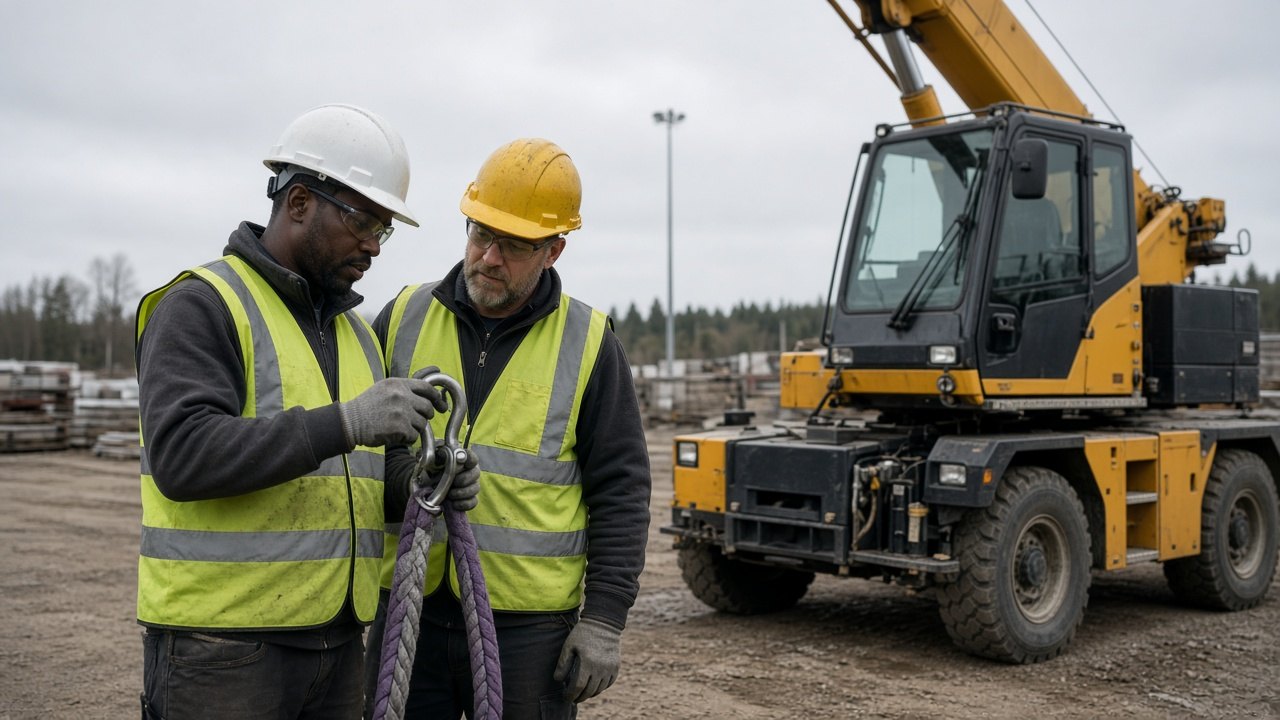
To become a crane operator, gain related experience, earn accredited certification, and pass an employer evaluation.
Crane operation is a high-responsibility career path. A certification card matters, but OSHA's construction crane rule also requires training and an employer evaluation of the operator's ability to run the actual equipment safely. One credential does not cover every crane or every lift.
Many people enter the work after time around heavy equipment, rigging, or signaling. BLS says crane and tower operators typically have several years of experience in a related occupation, such as construction equipment operation, hoist and winch operation, or rigging and signaling.
What does OSHA require for crane operators?
Under 29 CFR 1926.1427, the employer must ensure each operator of covered construction equipment is trained, certified or licensed, and evaluated before operating it, unless an exception applies. Operators in training must follow specific supervision and limitation rules.
When a state or local government license is required, that license applies. When it is not, the operator must be certified through an accredited crane operator testing organization or an audited employer program meeting OSHA's criteria.
Certification and evaluation are separate. Through the evaluation, the employer must ensure that the operator has the skills, knowledge, and ability to recognize and avert risk for that equipment, including its safety devices, operational aids, software, size, and configuration.
What is NCCCO certification?
CCO, the certification program from the National Commission for the Certification of Crane Operators, offers national certification programs for crane operators, riggers, signalpersons, inspectors, and other roles. CCO lists 17 national programs.
For mobile cranes, CCO lists specialties for lattice boom, fixed-cab telescopic boom, and swing-cab telescopic boom cranes. Its mobile crane page lists ASME B30.5 as the standard, a written and practical exam format, a five-year validity period, and Spanish availability.
The program also has its own eligibility rules. CCO says mobile crane candidates must be at least 18 years old and comply with its substance abuse policy and code of ethics. Read the current candidate handbook before applying.
What is on the mobile crane exam?
CCO's core mobile crane written exam has 95 multiple-choice questions and a 90-minute limit. The page lists knowledge areas for site conditions, operations, technical knowledge, and load charts.
Load charts carry heavy weight in the specialty exams. CCO's specialty outlines include rated capacity charts, range diagrams, gross and net capacity, maximum radius, and line pull. That means preparation is not only about controls. It is about understanding the machine's limits.
The practical exam is a separate requirement. CCO says you can pass the written and practical exams in either order and schedule the practical with a CCO Practical Proctor. Ask any training provider what equipment you will practice on and test with.
How do you get related experience?
Start where you can work safely around lifting operations. Equipment operation, rigging support, signaling, and yard work can teach site awareness, communication, and respect for exclusion zones. Never step into a lift role you have not been trained and authorized for.
OSHA requires materials to be rigged by a qualified rigger in certain operations, and signal persons must meet qualification requirements before giving signals. Those roles have their own standards and evaluation steps.
CCO offers separate rigger and signalperson certification programs. Some workers earn those credentials first because they match roles on lifting crews and teach the communication that operators depend on.
OSHA allows signal person qualification through a third-party qualified evaluator or through the employer's own qualified evaluator. Ask which documentation an employer accepts before you pay for an outside program.
Signal person qualification under 29 CFR 1926.1428 requires knowing and understanding the signals used, competence in applying them, a basic understanding of equipment operation and limitations, and demonstration through an oral or written test and a practical test.
Who pays for crane certification?
OSHA's crane rule states that whenever operator certification or licensure is required under the section, the employer must provide it at no cost to employees. Ask how a prospective employer handles that requirement before you pay for testing yourself.
Training outside a job is a different situation. Private schools set their own tuition, and costs vary by program, crane type, and practice time. Get an itemized quote that separates instruction, written exams, practical exams, equipment time, and retests.
If you are not yet employed, ask an American Job Center whether any approved crane-related training is available in your area. Funding depends on local programs and your eligibility.
How long does certification last?
CCO lists a five-year validity period for mobile crane operator certification. OSHA states that an accredited testing organization certification under that option is valid for five years.
Keep your certification current, but remember that the employer evaluation is separate. A new crane, configuration, or type of lift can require more evaluation, and the employer must determine you are qualified for assigned work.
Keep copies of your certification card, written and practical exam results, and any employer evaluation records. Ask each new employer which crane types and configurations its evaluation will cover, and who will supervise you while you gain experience on that equipment.
What do crane operators earn?
BLS reported a May 2025 national median annual wage of $68,080 for crane and tower operators. That figure reflects experienced workers across many settings. It is not a starting rate for a new certificate holder.
Pay depends on employer, location, equipment, union status, schedules, and experience. Ask about overtime, travel, seasonal work, and how new operators progress before choosing a program based on the median alone.
How should you present your experience?
List what you have actually done. Separate signaling, rigging, and operation, and name the equipment you used. Hirers need to know whether you watched lifts, helped rig loads, or operated a crane under evaluation.
Workers can find local trade and labor jobs free at https://chambanow.com. Browse construction jobs such as Houston at https://chambanow.com/jobs/in/houston-tx/construction or demolition jobs in Dallas at https://chambanow.com/jobs/in/dallas-tx/demolition to build site experience.
For first-day habits around heavy equipment, read a beginner's guide to construction site safety at https://chambanow.com/chambamatters/a-beginner-s-guide-to-construction-site-safety.
Frequently asked questions
Can I take a crane course with no experience?
Some schools accept beginners, but BLS says crane operators typically have several years of related experience. Ask how the program prepares you for actual job entry.
Does NCCCO cover all crane types?
No. CCO has separate programs and specialties. Choose the one that matches the equipment you will operate.
Is a crane certification enough to operate on my first day?
No. OSHA also requires employer evaluation for the equipment and assigned work.
Is the exam offered in Spanish?
CCO lists Spanish availability for its mobile crane operator program. Confirm current options for your exam when you apply.
Sources
- eCFR, 29 CFR 1926.1427 (https://www.ecfr.gov/current/title-29/subtitle-B/chapter-XVII/part-1926/subpart-CC/section-1926.1427)
- eCFR, 29 CFR 1926.1428 (https://www.ecfr.gov/current/title-29/subtitle-B/chapter-XVII/part-1926/subpart-CC/section-1926.1428)
- CCO, Certification programs (https://www.nccco.org/nccco/certifications)
- CCO, Mobile Crane Operator (https://www.nccco.org/nccco/certifications/mobile-crane-operator)
- BLS, Material Moving Machine Operators, May 2025 (https://www.bls.gov/ooh/transportation-and-material-moving/material-moving-machine-operators.htm)
Written by Barry Graham, Founder, ChambaNOW
Construyendo conocimiento que funciona.