
CDL Class A vs. Class B: Which License Should You Get?
Choose a Class A or B CDL by matching the truck, trailer, training, and tests to your target job.
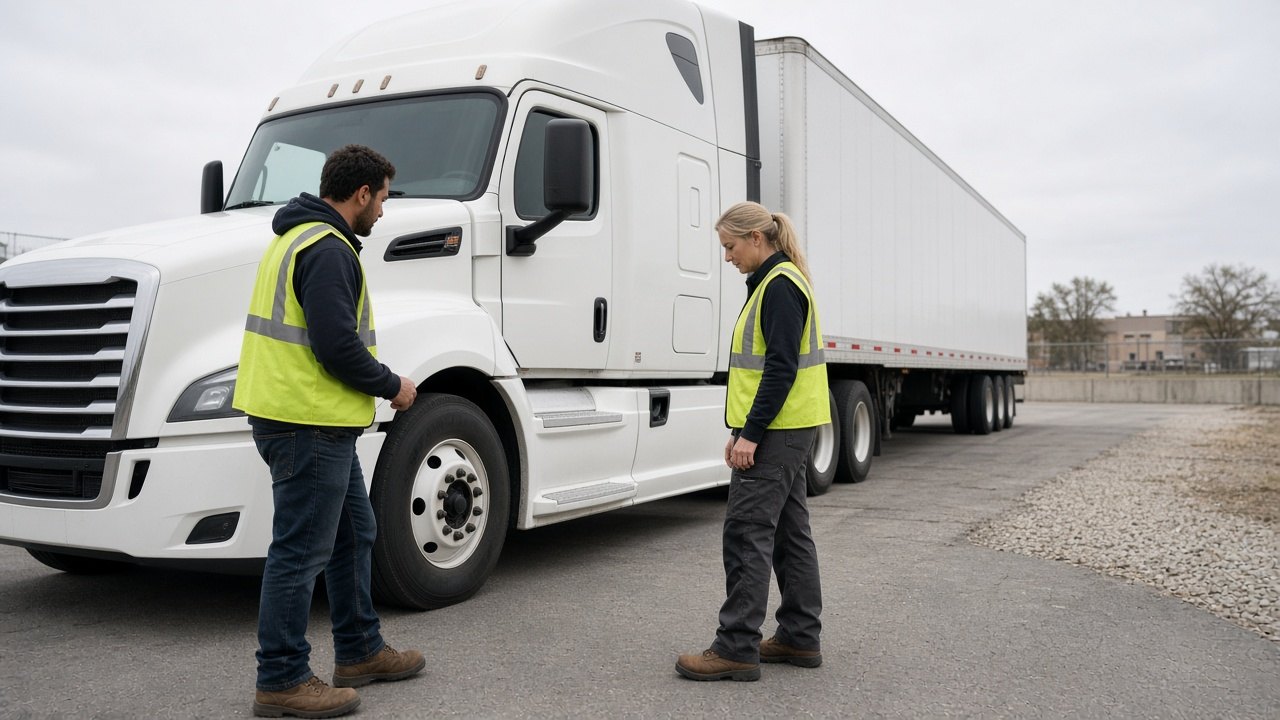
Choose a Class A or B CDL by matching the truck, trailer, training, and tests to your target job.
A commercial driver's license can open a different career path for someone already doing loading, construction support, or deliveries. But the right starting point is not simply the biggest truck you can afford to train on. It is the vehicle and work you actually want.
Class A and Class B are state-issued commercial license classes based on federal standards. They differ mainly in the vehicle combination involved. Both require more than collecting a school completion certificate, and neither guarantees a particular route or income.
What is the difference between Class A and Class B?
FMCSA defines Class A as a combination with a gross combination weight rating or actual combination weight of at least 26,001 pounds, whichever is greater, including a towed unit rated or weighing more than 10,000 pounds, whichever is greater.
Class B generally covers a single vehicle rated or weighing at least 26,001 pounds, or that vehicle towing a unit rated or weighing no more than 10,000 pounds. The precise ratings and operation matter; do not decide the class from a truck's appearance alone.
That is why a tractor-trailer commonly points toward Class A, while a heavy straight truck may point toward Class B. Passenger and hazardous-material operations can introduce additional requirements. Ask the licensing agency to confirm the class and endorsements for your intended vehicle.
Which class fits local trade work?
Look at actual openings before choosing school. A construction contractor may need a driver for a heavy straight truck, an equipment-hauling combination, or a vehicle below the CDL weight threshold. Those are not interchangeable assignments.
Compare the work as well as the license.
- The truck and trailer configuration used on the job
- Whether the employer needs air brakes or a manual transmission
- Whether loading, unloading, or equipment handling is part of the shift
- Whether routes are local, regional, or long-distance
- Whether passengers or specialized cargo require endorsements
A Class A license may cover qualifying lower-class vehicles, but only when you meet applicable endorsement and restriction rules. More license does not mean unrestricted permission for every commercial operation.
How do you start the licensing process?
Begin with your state's commercial driver handbook and licensing agency. Confirm eligibility, identification requirements, medical certification category, application fees, testing arrangements, and the class you need. Requirements and fees vary by state.
The commercial learner's permit, or CLP, allows supervised learning under specific conditions. Federal rules require the accompanying CDL holder to be qualified for the vehicle and appropriately positioned to supervise. It is not permission to take a commercial job driving alone.
Under 49 CFR 383.25, a CLP holder cannot take the CDL skills test in the first 14 days after initial permit issuance. That is a minimum waiting period, not a claim that a beginner will be ready after two weeks.
What training is required?
FMCSA's Entry-Level Driver Training rules generally apply to a first Class A or Class B CDL and to an upgrade from Class B to Class A. There are exceptions, so confirm your individual situation rather than relying on a classmate's experience.
Required training must come from a provider listed in FMCSA's Training Provider Registry. For a first Class A or B license, the applicable curriculum includes theory and behind-the-wheel instruction. Completing a permit study app is not the same as completing ELDT.
Federal ELDT curricula do not set a universal minimum number of instruction hours for Class A or B. They require coverage of the curriculum and demonstrated proficiency. State rules and individual schools can add requirements. Ask separately about classroom time, actual driving time, and how proficiency is measured.
What happens at the skills test?
The CDL process includes knowledge and skills testing relevant to the vehicle. Your state explains scheduling, vehicle inspection, basic control, and on-road requirements in its current handbook. Practice the procedures your examiner will expect, not a memorized script from an outdated video.
The test vehicle can affect your license. FMCSA identifies restrictions for automatic transmissions, air-brake configurations, and certain tractor-trailer connections. Ask the school exactly what restrictions its test vehicle could produce.
If your target employer uses manual transmissions or full air brakes, discovering an incompatible restriction after graduation can delay your application. Get a clear answer before enrollment about the equipment available for training and testing.
How much does a CDL cost?
There is no single federal school tuition rate. Separate school tuition from permit and license fees, medical examination costs, test charges, vehicle access, and possible retests. Request an itemized written estimate from each provider.
Ask whether an employer sponsors training or whether a local workforce program can help. CareerOneStop directs workers seeking WIOA-funded training to an American Job Center for eligibility review. Funding is conditional; a school advertising assistance does not mean your application is approved.
Compare the full commitment, including lost work time and travel. A lower tuition quote can be less useful if the school offers little individual driving practice or cannot explain when you will have access to a test vehicle.
What could you earn?
BLS reported a May 2025 national median annual wage of $58,640 for heavy and tractor-trailer truck drivers. That is not a starting salary, and the occupation includes different employers, routes, experience levels, and schedules.
Ask how an offer calculates pay, what loading or waiting time involves, and what schedule is expected. Do not compare a mileage-based advertisement directly with an hourly job without understanding the duties and hours behind it.
Workers can find local trade and labor jobs free at https://chambanow.com while preparing for a driving career, such as construction jobs in Phoenix at https://chambanow.com/jobs/in/phoenix-az/construction. Our guide on moving from general labor into a skilled trade at https://chambanow.com/chambamatters/how-to-move-from-general-labor-into-a-skilled-trade can help you organize the transition without overstating your current qualifications.
Frequently asked questions
Is Class A always better than Class B?
No. Choose the license that matches a realistic job goal, equipment access, and training commitment. A suitable local Class B opening may fit your needs better than a route requiring Class A.
Can I get a CDL entirely online?
No. Theory instruction can be delivered online by eligible providers, but required behind-the-wheel training and skills testing cannot be replaced by watching videos.
Can I upgrade later?
Yes, but an upgrade has its own requirements. FMCSA generally requires ELDT for a Class B-to-A upgrade. Ask the state what testing and documentation apply before booking another course.
What is the best next step?
Identify a target vehicle and employer, read the state handbook, then compare registered training providers. Choosing the class first without understanding the job can mean paying for the wrong preparation.
Sources
- FMCSA, Drivers and license classifications (https://www.fmcsa.dot.gov/registration/commercial-drivers-license/drivers)
- FMCSA, Entry-Level Driver Training (https://www.fmcsa.dot.gov/registration/commercial-drivers-license/entry-level-driver-training-eldt)
- eCFR, 49 CFR 383.25 (https://www.ecfr.gov/current/title-49/subtitle-B/chapter-III/subchapter-B/part-383/subpart-B/section-383.25)
- eCFR, 49 CFR Part 380, ELDT curricula (https://www.ecfr.gov/current/title-49/subtitle-B/chapter-III/subchapter-B/part-380)
- CareerOneStop, Find money for training (https://www.careeronestop.org/FindTraining/Pay/find-money-for-training.aspx)
- BLS, Heavy and Tractor-Trailer Truck Drivers, May 2025 pay (https://www.bls.gov/ooh/transportation-and-material-moving/heavy-and-tractor-trailer-truck-drivers.htm)
Written by Barry Graham, Founder, ChambaNOW
Construyendo conocimiento que funciona.