
Cash, Check, or App: How to Pay Day Laborers and Keep Records
You can pay a day laborer by cash, check, bank transfer, or payment app. Federal law does not require one method. What the law and good practice do require is that the worker gets
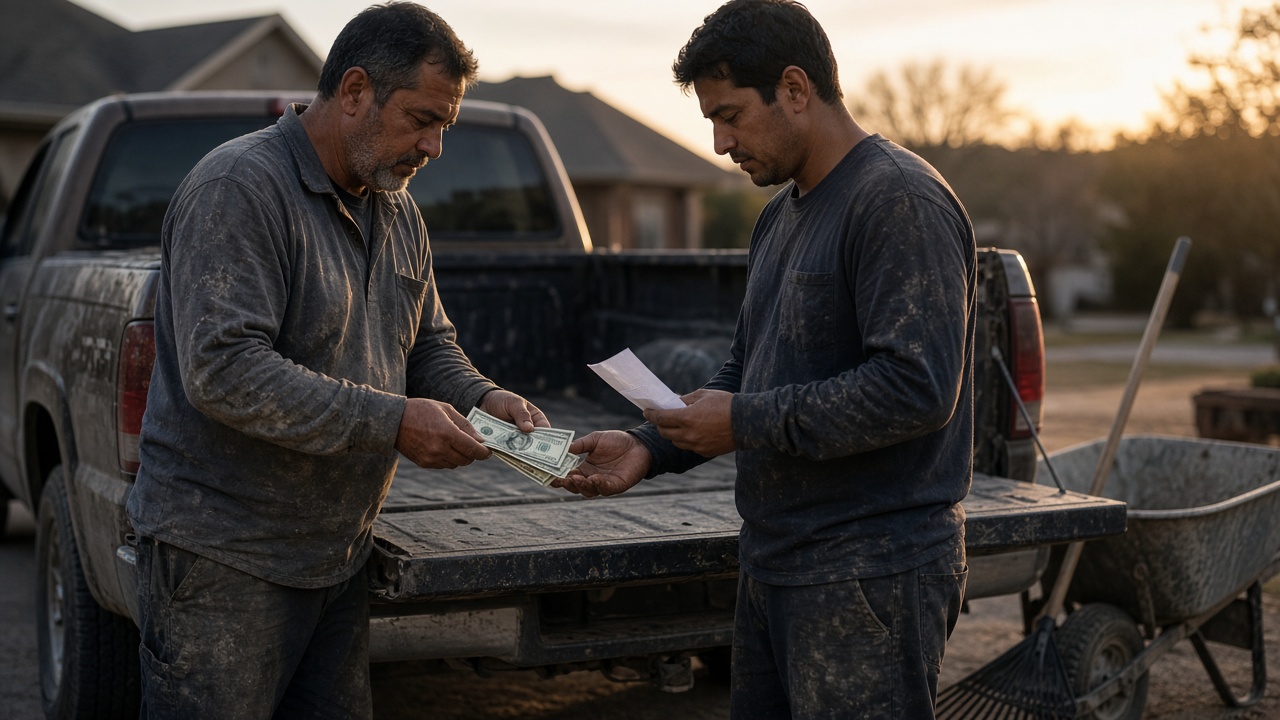
You can pay a day laborer by cash, check, bank transfer, or payment app. Federal law does not require one method. What the law and good practice do require is that the worker gets the full agreed amount, on time, and that you keep a record of the date, the hours or job, the amount, and how you paid. For employees, the Department of Labor lists the exact records you must keep. For independent contractors paid by a business, the IRS expects a Form W-9 and accurate payment totals. A one-page receipt at the end of every job covers most of what both sides need.
This article is general information, not legal or tax advice. State payroll laws can add requirements, such as written wage statements. Check the official sources below or ask a qualified professional.
How do the payment methods compare?
Each method has tradeoffs for speed, proof, and tax reporting.
- Cash: immediate and accepted by everyone; weakest proof of payment unless you both sign a receipt; for businesses paying non-employees, cash counts toward the Form 1099-NEC threshold
- Check: creates a bank record; slower for workers without a bank account and may come with check-cashing fees; counts toward the 1099-NEC threshold
- Direct bank transfer: fast with a clear record; requires sharing account details, so protect that information; ordinary bank transfers that are not third-party network transactions also count toward the 1099-NEC threshold
- Payment app or card network: fast and leaves a digital trail; the IRS says payments made by payment card or through third-party networks are reported on Form 1099-K by the payment settlement entity, not on Form 1099-NEC by the payer
Whatever you choose, agree on it before work starts. A worker who expects cash at 5 p.m. and gets a promise of a check next week has a fair complaint.
What changes for taxes with each method?
For a business paying an independent contractor, the December 2026 IRS instructions say payments made with a credit card or payment card, and third-party network transactions, must be reported on Form 1099-K and are not subject to reporting on Form 1099-NEC (https://www.irs.gov/pub/irs-pdf/i1099mec.pdf). Cash, checks, and ordinary transfers stay on your side: if they total $2,000 or more to one payee in 2026, you generally file Form 1099-NEC.
Payment apps themselves only have to issue a Form 1099-K when a person's payments for goods or services exceed $20,000 and the number of transactions exceeds 200, though they may issue one for lower amounts and some states set lower thresholds (https://www.irs.gov/businesses/understanding-your-form-1099-k). Workers must report all income either way.
For homeowners with a household employee, IRS Publication 926 says "cash wages" include wages paid by check, money order, and similar means, so the method does not change whether the $3,000 threshold for Social Security and Medicare taxes in 2026 is met (https://www.irs.gov/publications/p926).
What records must you keep for an employee?
If the day laborer is your employee under the Fair Labor Standards Act, the Department of Labor's Fact Sheet 21 lists the basic records (https://www.dol.gov/agencies/whd/fact-sheets/21-flsa-recordkeeping). No particular form is required, but the information must be accurate.
- Full name and Social Security number
- Address, including ZIP code
- Birth date, if younger than 19
- Sex and occupation
- Time and day of week the workweek begins
- Hours worked each day and total hours each workweek
- Basis of pay, such as hourly, daily, or by the job
- Regular hourly pay rate
- Total straight-time earnings and total overtime earnings
- All additions to or deductions from wages
- Total wages paid each pay period
- Date of payment and the pay period covered
The Department of Labor says payroll records must be kept at least three years, and records on which wage calculations are based, such as time cards, at least two years (29 CFR part 516).
What records should homeowners keep?
IRS Publication 926 tells household employers to record, on each payday, the date and amount of the employee's cash and noncash wages and any taxes withheld, and to keep employment tax records for at least four years. Even when you do not have to file a Form W-2, the IRS encourages you to give your household worker a receipt that includes the dates worked, the wages paid, and a general description of the work. That is good practice for any one-day job.
What records should a business keep for an independent contractor?
- A completed Form W-9 collected before the first payment; the IRS says to keep it for four years (https://www.irs.gov/businesses/small-businesses-self-employed/forms-and-associated-taxes-for-independent-contractors)
- The written quote or agreement for the job
- Date, amount, and method of every payment
- Invoices or receipts signed or acknowledged by the worker
- Copies of any Form 1099-NEC you file
What should a day-labor payment receipt include?
A simple receipt, on paper or in a message thread, protects both sides. Include:
- Worker's name and hirer's name and phone number
- Job address and date
- Start time, end time, and any unpaid meal break
- Rate and basis, such as $24 per hour, $200 per day, or $350 for the job
- Total hours or job description
- Any additions, such as mileage or dump fees, and any agreed deductions
- Total paid, payment method, and time of payment
- A line both people sign or a message both people acknowledge
Writing the receipt in the worker's language helps avoid disputes. If you and the worker do not share a language, a bilingual template or a translated message can make the terms clear.
Can you deduct the cost of tools or damage from pay?
Be careful. For employees, federal rules require wages to be paid "free and clear." The regulation at 29 CFR 531.35 says that if an employer requires an employee to provide tools of the trade for the employer's work, there is a violation in any workweek when the cost of those tools cuts into the minimum or overtime wages required (https://www.ecfr.gov/current/title-29/subtitle-B/chapter-V/subchapter-A/part-531/subpart-C/subject-group-ECFRd42c2e4b995d7cd/section-531.35). Many states restrict deductions further. The safest practice is to agree on who supplies tools before the job and not to make surprise deductions at the end.
Why does prompt, documented payment matter so much?
Unpaid wages are a long-standing problem in day labor. The 2006 "On the Corner" national study found that almost half of day laborers had experienced at least one instance of wage theft in the two months before the survey (https://www.coshnetwork.org/sites/default/files/Day%20Labor%20study%202006.pdf). A clear receipt and an on-time payment build trust, help you rehire good workers, and give you proof if a dispute ever comes up.
Best practices checklist
- Agree on the amount, the basis, the method, and the time of payment before work starts
- Pay on the same day for one-day jobs unless you agreed otherwise in writing
- Bring exact cash or confirm the app transfer went through before the worker leaves
- Give a written receipt every time
- Collect a W-9 from independent contractors if you are a business
- Keep payroll and receipt records for at least three to four years
- Do not deduct for tools, breakage, or lateness without a clear, lawful agreement
How can a platform help with records?
A job post and message thread create a timestamped record of what was agreed. On ChambaNOW, posting a job is free, hirers contact workers about a specific posted job, and messages can be translated between English and Spanish, which helps both sides confirm the rate and payment terms in writing. Hirers can review the process at https://chambanow.com/for-hirers. Workers, who always use ChambaNOW free, can read about the right to be paid at https://chambanow.com/chambamatters/your-right-to-be-paid. For broader payment options for contractors, see https://chambanow.com/chambamatters/contractor-pay-methods.
Key takeaways
- Cash, checks, transfers, and apps are all lawful; agree on the method in advance
- Card and third-party app payments are reported on Form 1099-K by the processor; cash and checks count toward your 1099-NEC total
- Employers must keep the Department of Labor's listed payroll records for three years
- Give every worker a receipt with dates, hours, rate, and total paid
- Avoid deductions that push an employee's pay below minimum wage
Sources
- U.S. Department of Labor, Fact Sheet 21: Recordkeeping Requirements under the FLSA; 29 CFR part 516; 29 CFR 531.35
- IRS, Publication 926 (2026)
- IRS, Instructions for Forms 1099-MISC and 1099-NEC (Rev. December 2026)
- IRS, Understanding your Form 1099-K
- IRS, Forms and associated taxes for independent contractors
- "On the Corner: Day Labor in the United States," 2006
Written by Barry Graham, Founder, ChambaNOW
Building knowledge that works.